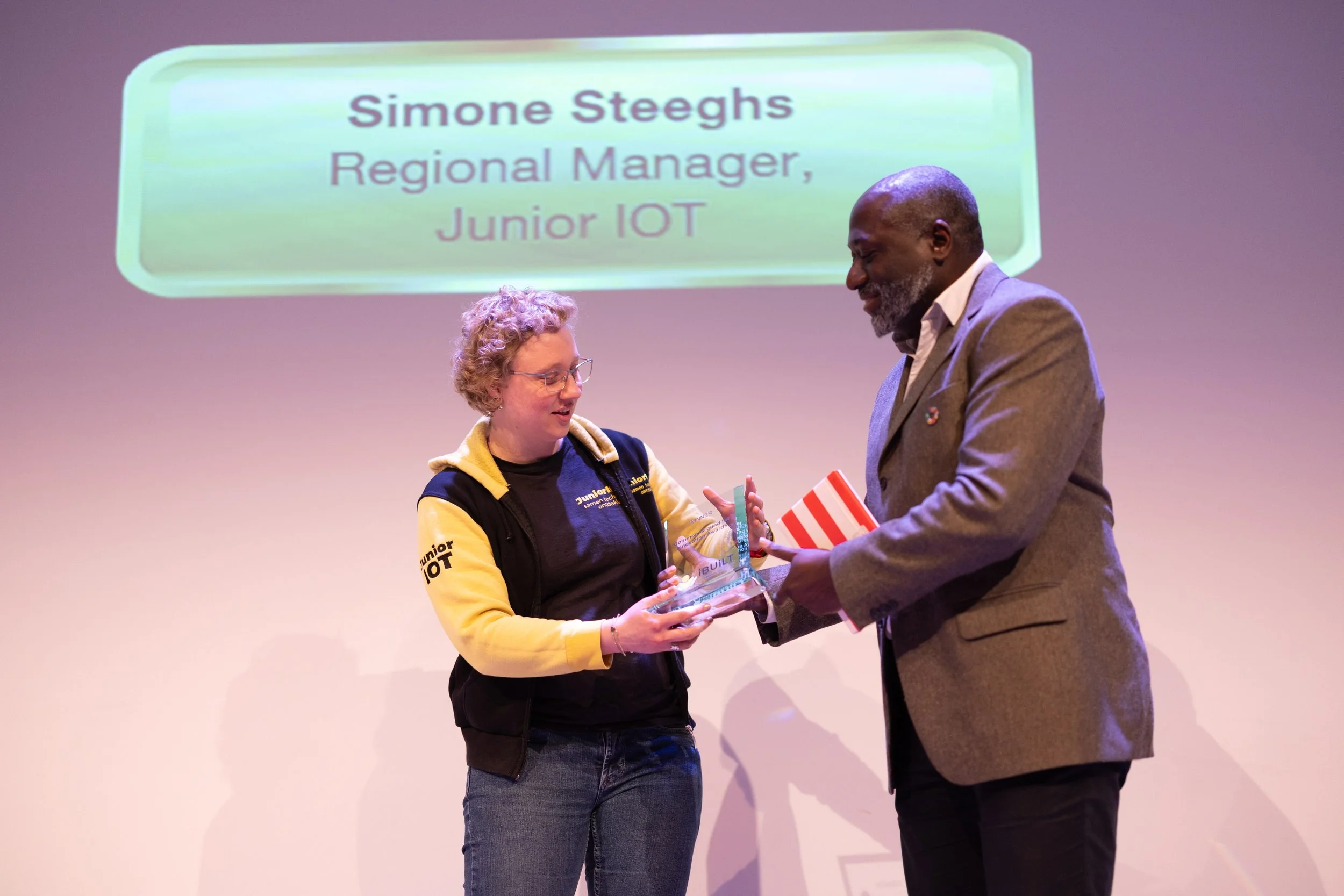
Speech Ruben Brave - iBuilt Common Grounds Award 2026
“We must recognize that we can’t solve our problem now until there is a radical redistribution of economic and political power… this means a revolution of values and other things.”
Good evening everyone,
When we talk about inclusion in tech, the conversation too often begins at the top.
Who gets funded. Who gets hired. Who gets invited into leadership. Who gets seen.
Those are important questions. But they come too late if we ignore an earlier one: who gets to imagine, from the very beginning, that technology is also for them?
This matters deeply to me, not only through my work at Dutch New Narrative Lab, but also through my roles as Chair of the Internet Society Netherlands, as a member of the Supervisory Board of the Netherlands Youth Institute, and as a contributor to the OECD Youth Entrepreneurship Policy Academy.
I know how important that early moment can be. When I was in primary school, I had a teacher and school director who recognised my passion for technology very early on. He allowed me, free from background and from all the narrative noise that can surround a child, to experiment with a cabinet full of chemistry and physics materials. I was about ten years old. There was just one condition: that I would share my experiments with my classmates by giving presentations to them.
Looking back, I realise that what he gave me was more than space to explore. He gave me a sense that curiosity could belong to me, and that knowledge was not something to keep to yourself, but something to open up for others.
Real change does not start in the boardroom. It starts much earlier. It starts in the classroom, in the neighbourhood, the moment a child first encounters technology not as something distant, but as something they can shape with their own hands.
That is why the work we honour tonight matters so much.
The person receiving this award has been building something profoundly important: not just programmes, not just workshops, but a bridge. A bridge between children and technology. Between curiosity and confidence. Between the promise of a region known for innovation and the much harder task of making that innovation truly belong to everyone.
She works with schools, families, educators, and young people who might otherwise grow up believing that tech is for other children, other neighbourhoods, other futures.
And what I find especially powerful is this: her work does not treat inclusion as an afterthought or a branding exercise. It treats inclusion as infrastructure.
At Dutch New Narrative Lab, we often say that innovation becomes stronger when more people can see themselves inside it. Not as spectators. Not as beneficiaries. But as builders, makers, founders, engineers, and authors of the future.
That is exactly what this social innovator is doing.
She reminds us that the future of tech will not be decided only by the breakthroughs we celebrate, but by the doors we open early enough for others to walk through them.
The winner of the 2026 Social Innovator Award is… Simone Steeghs..